Wedding Venue Acoustic Audits
An acoustic audit gives you a detailed, evidence-based understanding of how your venue behaves acoustically — before decisions are made, money is spent, or a complaint arrives.
What the audit examines
Existing acoustic performance
Noise transmission routes
Building construction
Surrounding properties
Noise-sensitive areas
Existing sound systems
Event layouts
Operational practices
Potential acoustic risks
Seven stages from first conversation to action plan
Initial consultation
We discuss how the venue operates, the events you host and the concerns or ambitions behind the audit.
Venue information review
Plans, photographs, previous studies, system inventories, permissions and any correspondence relating to noise.
Site inspection
A walkthrough of every event space, boundary and neighbouring relationship, indoors and outdoors.
Acoustic measurements
Measurements appropriate to the venue and the question — internal levels, transmission and the surrounding sound environment.
Analysis
Interpretation of the measured data against how the venue actually operates across ceremony, dinner and late-night use.
Recommendations
Practical, venue-specific measures covering the building, the sound system and operating practice.
Prioritised action plan
A sequenced plan so you know what to address first and what can reasonably wait.
Recommendations you can budget against
Essential
Measures we consider necessary to address identified acoustic risk or to support the venue's regulatory position.
Recommended
Measures that meaningfully improve the acoustic outcome or resilience of the venue without being strictly necessary.
Optional / Optimisation
Refinements to guest experience, coverage quality and operational convenience.
This distinction exists for one reason: so that venue owners understand where money should be spent first.
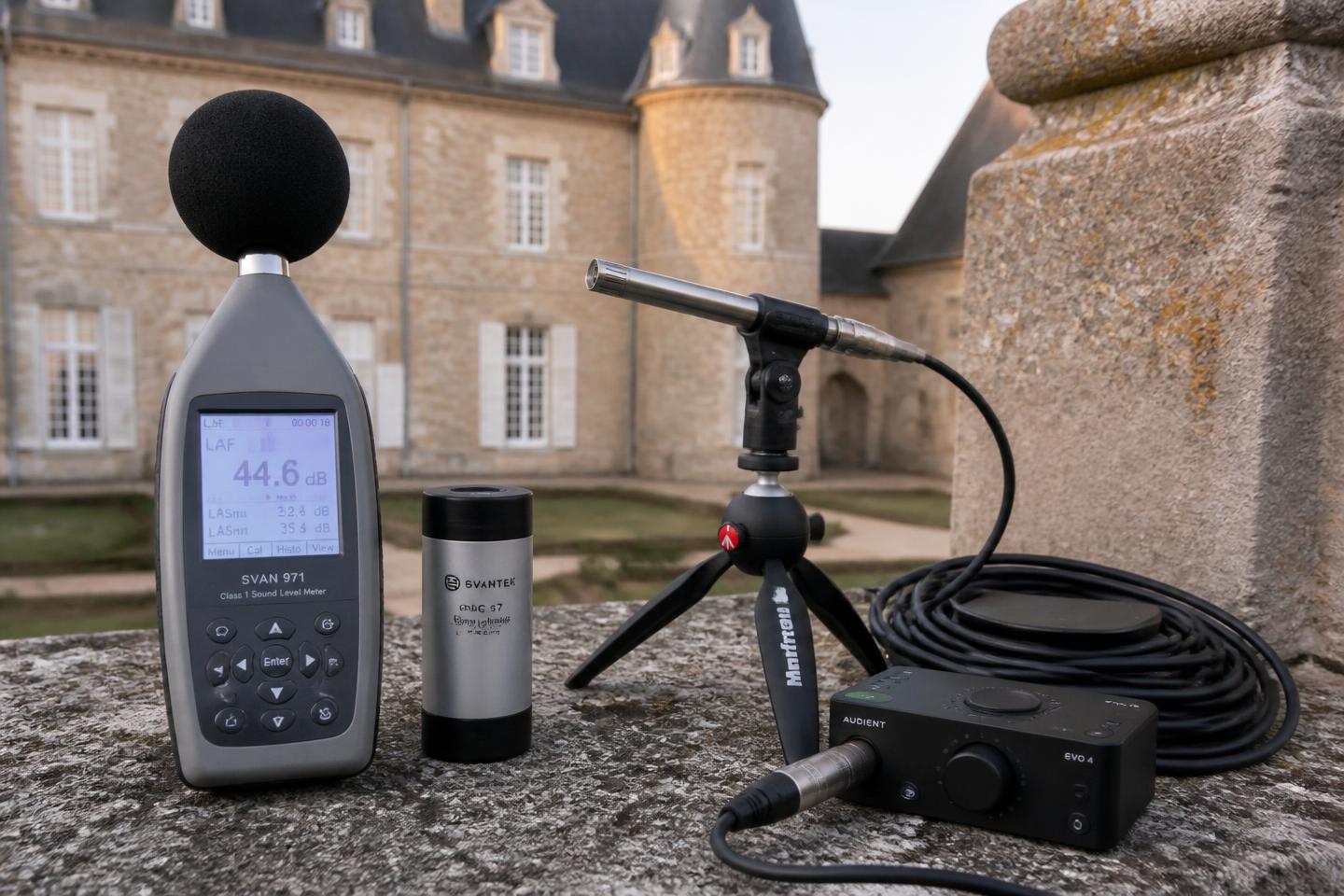
Measured with calibrated instruments
Assessments are carried out with Class 1 integrating sound level meters, field calibrators, free-field measurement microphones and multi-channel recording — checked before and after each measurement session so the figures in your report can be relied on and repeated.
Distance helps. It rarely helps as much as people expect.
Low frequencies in particular travel further and pass more easily through building fabric, which is why party-stage measurements are taken at the receiver, not only at the source.
How level falls between the dance floor and the boundary
Idealised free-field decay. On a real site, ground cover, screening, wind and temperature all modify the result, which is why levels are measured rather than assumed.
Understand your venue before problems arise.
Tell us about your venue. We will assess the information and advise you on the most appropriate next step.